

The Centre Gabriel-Fugère will carry out its project in a new host community
Archives · July 8, 2026
Official statement
The Centre Gabriel-Fugère (CGF) announces that it is ending the steps related to the housing, specialized services and research project for adults with ID-ASD planned on lots 6 464 714 and 6 357 518 in Sainte-Anne-des-Plaines. This decision follows an analysis of the municipal context and an assessment of the conditions required to carry the project forward.
Having received a letter from the town's general management stating that the CGF would have to acquire the land and complete the work leading to a building permit by October 2026, the CGF finds that the conditions needed to pursue the project are not in place.
Between 2023 and 2026, the CGF held many meetings with the municipality, the MRC Thérèse-De Blainville, the CISSS des Laurentides, professional firms and various institutional partners. The project went through technical, administrative and financial steps, including preliminary plans, specialized studies and consultations. After the change of municipal administration in November 2025, exchanges became scarcer and the preparatory work slowed down.
Let us recall that more than 110,000 adults with ID-ASD (intellectual disability and autism spectrum disorder) live in Québec, and that several thousand of them are waiting for housing. The CGF project aims to help hundreds of them age better each month, while giving their caregivers more respite.
Considering all of these elements, the CGF is therefore ending the process tied to the purchase option set out in the Agreement of December 20, 2024.
The organization sincerely thanks the directors of municipal services, the MRC Thérèse-De Blainville, its institutional partners, the professional firms and the citizens who have supported the project since the beginning.
The CGF will keep studying the options it has been offered to relocate the project. More details will follow on our website.
Centre Gabriel-Fugère
[email protected]
www.centregabrielfugere.com
Here are excerpts from the letter we sent to the Town of Sainte-Anne-des-Plaines (SADP). Some elements were changed or added for clarity.
…
How the work unfolded
(This section is meant to make clear everything that was actually done):
May 2023
Sainte-Anne-des-Plaines is proposed to the CGF as a host community.
July 4, 2023
A meeting takes place at École des Érables in Deux-Montagnes with elected officials. All are deeply moved by the project and see its potential reach, well beyond the municipal level.
September 2023 to May 2024:
Dozens of meetings are held with local stakeholders to shape the project: the CISSS des Laurentides, the management of École des Érables, architects, the MRC, the director of urban planning, the general management of SADP and the mayor.
Since we were starting from the plans of École des Érables in Deux-Montagnes, the main goal was to modernize those plans and adapt them to the needs of our adult clientele.
Discussions begin with the CMM (Communauté métropolitaine de Montréal) to access the Metropolitan Social Housing Fund, which would cover the municipal share (40%) of the financing under the Programme Habitation Abordable Québec (PHAQ). The person in charge of the file at the CMM considers that the housing part of our project fits this program perfectly.
November 2023
The CGF receives several letters and messages of support (shown further down on the site).
June 2024
The CGF signs a six-month purchase agreement for the land on lots 6 464 714 and 6 357 518.
September 2024
First meeting to define the needs for a PPCMOI.
What is a PPCMOI?
A PPCMOI (projet particulier de construction, de modification ou d'occupation d'un immeuble) is a municipal procedure that allows a real estate project that does not fully match the usual zoning rules to be authorized.
In short, a PPCMOI is used to:
review a project case by case;
offer regulatory flexibility when a project has particular features;
frame the project with precise conditions;
consult citizens when required.
It is a tool used for specialized or innovative projects, or for projects that need to fit into their surroundings in a particular way.
October 2024:
Meeting with elected officials from every level of government (municipal, MRC, provincial and federal) and with directors of municipal services
The MRC gives the Centre Gabriel Fugère (CGF) a $30,000 donation for the studies required to carry out the project
Land surveying
November 2024:
A firm is hired as project and financing manager.
Preparation of the business plan and (preliminary) costs
Meeting with the GRT (technical resource group) about the social housing units
Environmental study of the land
December 2024:
Adoption, with no opposition from citizens or anyone else, of the resolution allowing the Town of SADP to buy the land in question in order to secure the site for the project
January 2025:
Call for projects to choose an architecture firm (three firms will submit proposals)
February 2025:
Official launch of the website
Choice of the architecture firm
Presentation of the project at the CCITB mayor's luncheon (the chamber of commerce). After this presentation, many contractors offer to contribute pro bono (sprinkler systems, electrical work, indoor and outdoor signage, etc.).
March 2025:
The purchase of the land by the Town of SADP is made official
Start of several meetings between the architects and the partners, mainly the urban planning department, with a view to filing a PPCMOI application.
April 2025:
An organization presents us with a firm letter of intent to rent 20 housing units for at least 25 years, for a clientele made up mainly of young adults with developmental language disorder (DLD) and certain associated conditions, including ASD.
June 2025
Presentation of the first architectural plans, 10% complete, to the municipal departments for comments. The architects take note of the points of attention raised by urban planning, public works and public safety. One particular consideration is the proximity of provincial route 335 and chemin Gibson, which leads to the Archambault complex, where street parking is prohibited.
July 2025
The MRC gives the CGF a $10,000 donation under its fund for the development of social economy and sustainable development enterprises (FDEÉSDD).
August 2025
Filing of the ecological characterization report.
September 2025
The architects submit the plans, 30% complete, to the municipality for comments. Invited to this meeting are, among others, the general management, the public works department, the urban planning department and the elected officials.
All departments are in favour of the project, except for one item that must be resolved before filing the PPCMOI: a shortage of 20 parking spaces
Several solutions are considered, including enlarging the underground parking or buying the neighbouring lot.
New architectural renderings
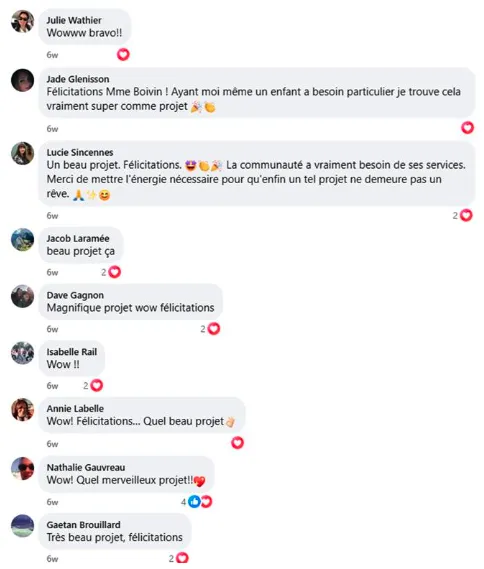
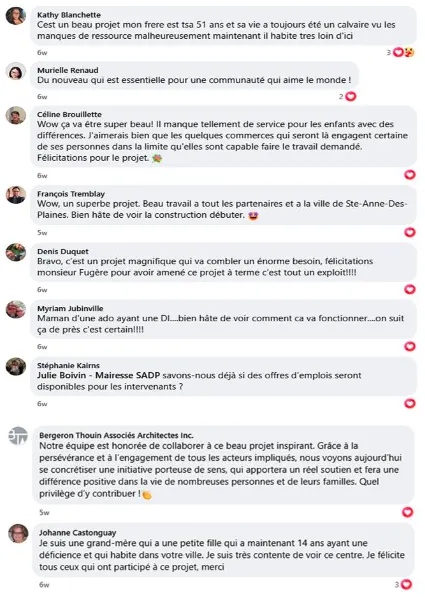
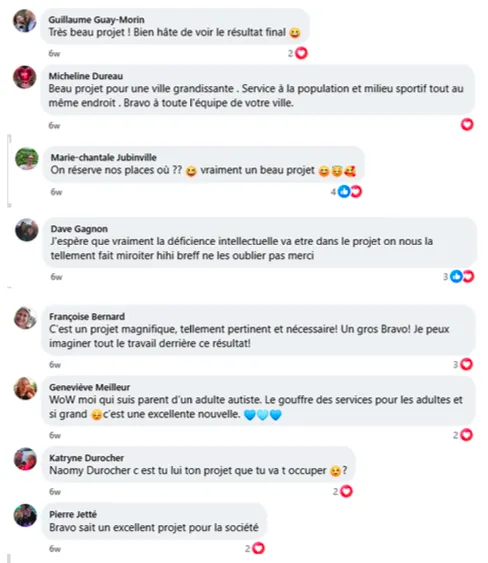
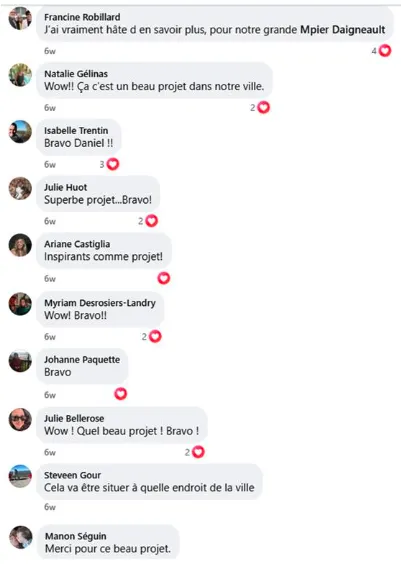
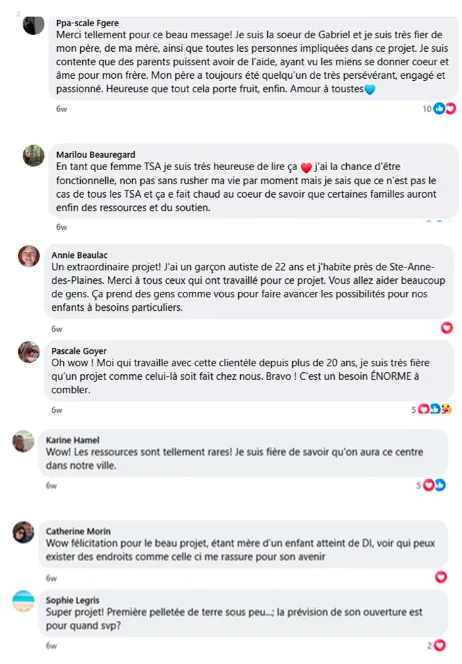
Facebook post on the mayor's page to present the project and the architectural renderings to citizens, and publication of the renderings on the website. Needless to say, the response was exceptional, as shown by the statistics and the very many comments from citizens of SADP and elsewhere, which you can read in appendix 11. We are talking here about very strong social acceptance of the project.
Commitment from the mayor that, after the elections, she would apply under component 1 of the Fonds région et ruralité to secure regional support and make the CGF a regional flagship, given how unique it is. The mayor also proposes to request a regional mandate for the CGF (as École des Érables has), meaning that the CGF would not be limited to one town but would serve every town that needs its services, which for the host town means jobs and recognition
October 2025:
We send requests for proposals to various engineering firms.
November 2025:
November 20, meeting with the new mayor of SADP and the director general
January 19, 2026:
A meeting request from the mayor was passed on to us, and a meeting was set for February 6, 2026 at 9 a.m. The meeting did take place, but without the mayor. We do want to point out that three councillors who were present showed interest in the project.
NOTE: for reasons beyond our control, we had to pause the financing efforts, which were already well under way at that point.
We had committed to giving the town's elected officials written news of the project before the end of April, which we did.
Etc.
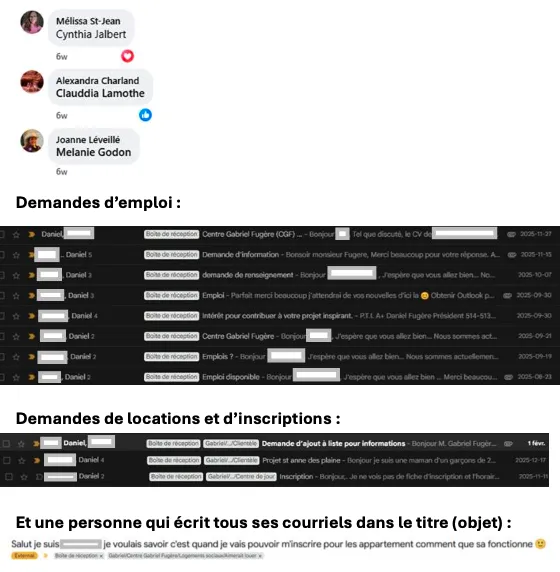
Social acceptance.
Reactions following the presentation of the project on social media (which represents about 300,000 indirect views).
SIMPLY INCREDIBLE!
THANK YOU SO MUCH!!
Where we stand since 2026
(By Daniel Fugère)
In September 2025, I came across an article titled "What we do (and don't know) about autism and ageing – new research" (https://theconversation.com/what-we-do-and-dont-know-about-autism-and-ageing-new-research-264140). At that time I also discovered a hard reality: among people with Down syndrome, and some people living with ASD, about 77% develop Alzheimer's disease starting in their twenties. The disease progresses slowly, over 10 to 20 years, before it becomes truly visible.
My son Gabriel is 29. He has Down syndrome (trisomy 21) and moderate to severe ASD. For many autistic people and people with Down syndrome, 45 is a critical age, often marked by a significant decline.
Another figure struck me deeply: even though about 70 million people worldwide live with ASD, less than 1% (0.14%) of the world's research looks at how these people age. It is a troubling reality, but it also explains why there is an urgent need to build adapted, stable and lasting living environments for autistic adults and adults with Down syndrome as they grow older.
In 2026, the Centre Gabriel Fugère decided to set up the International Center for Research on Autistic Adult Aging (ICRAAA, in French the Centre international de recherche sur le vieillissement des adultes autistes, CIRVAA). The CIRVAA / ICRAAA will be part of the CGF.
Virtual at first, the CIRVAA / ICRAAA is meant to be a true hub, working with universities, research centres, clinicians, support workers, physicians and others all over the world. The CIRVAA / ICRAAA will be set up over the course of the year.
Once the day centre is built, our centre will offer one of the best study populations there is, making it possible to develop concrete solutions that help autistic people and others age better. We are talking about artificial intelligence (my own field of expertise), robots able to detect particular behaviours, training tools for support workers, biological and physiological research, and so on.
Elected officials, organizations, many individuals and the Université de Sherbrooke have already shown interest. We also plan to work with École des Érables on joint research projects.
The CIRVAA / ICRAAA is meant to be independent from universities and organizations while working fully with them. Given how little research exists in this field, we want to bring as many partners as possible to the table rather than be tied exclusively to a single university, for example.
Soon (fall 2026), this website will host pages entirely dedicated to the CIRVAA / ICRAAA.
Other references:
L'Express, Fédération québécoise de l'autisme (autism and aging file)
Parents of autistic adults cannot die:
https://cdn-contenu.quebec.ca/cdn-contenu/adm/org/ophq/Administration/PEPH/Rapports_recherche/Soutenir-parents-adultes-autistes.pdf?utm_source=Cyberimpact&utm_medium=email&utm_campaign=infolettre---debut-avril-2026-mt
The CGF – Alain Doucet endowment fund.
Also in 2026, we were extremely fortunate to receive remarkable donations that allowed us to create our endowment fund (fonds de pérennité). An endowment fund is a sum of money invested for the long term to support a mission. The money is not spent directly: it is invested, and the income it generates (interest, returns) is what finances projects.
In simple terms:
• The capital stays intact.
• It produces income every year.
• That income supports a cause or an organization.
It is a way to create a stable, lasting and secure source of financing that keeps supporting the mission for decades. The fund is administered by iA Financial Group (Industrial Alliance).
The CGF – Alain Doucet endowment fund accepts contributions of $20,000 and more. In line with best practices in the sector, 75% of each donation goes into the capital of the endowment fund, where it is invested for the long term. The remaining 25% supports the CGF's mission and keeps its operations going.
Every donor receives a tax receipt. Recognition and exclusive events will be offered according to different giving levels (for example: $100,000 to $150,000, CIRVAA / ICRAAA conferences, VIP evenings with certain researchers, etc.). A very special thank you to Mr. Alain Doucet, whose generosity made the creation of this fund and all of these initiatives possible.
Community savings (in development)
The Centre Gabriel-Fugère is currently working on a community savings mechanism that will let citizens, families and partners invest directly in the CGF's mission. This product will offer a simple and accessible way to support the project while earning a socially responsible return.
Thanks to the CGF – Alain Doucet endowment fund, which provides a solid and lasting financial base, developing this kind of innovative tool becomes possible.
A simple example: 5% for 5 years
As an illustration, a person could invest an amount (for example $1,000 or more) and receive 5% interest per year for 5 years, while contributing to a project that is essential for adults with ID-ASD. This model provides at the same time:
a stable return for the saver;
structured financing for the CGF;
a direct social impact for the community.
No tax receipt is possible for this mechanism.
More details will be announced soon on our website.
Of course, ordinary donations are accepted, will always be accepted and welcome, and a tax receipt is issued for each of them.
With the CIRVAA / ICRAAA, the CGF – Alain Doucet endowment fund and community savings, we now have solid levers that can be used internationally. These three pillars will allow the CGF to build partnerships, attract scientific collaborations and support innovative projects beyond Québec.
Thank you.
See you soon.
July 8, 2026
Daniel Fugère
Director General
[email protected]

Contact
Daniel Fugère,
General Manager
Head Office:
212-B boul. Labelle Rosemère
(Québec) J7A 2H4
© 2026 Gabriel Fugère Centre – All rights reserved – Website created by Intralys